“Energy efficient space heater” is one of the most searched phrases every winter. Here’s the honest answer up front: every electric heater converts practically all of its electricity into heat. What makes a heater economical is the right wattage, a thermostat, a timer – and using it in a targeted way. We’ll show you what matters and which heater is cheapest to run.
Does an “energy efficient” space heater really exist?
The physics are simple: 1 kWh of electricity produces about 1 kWh of heat – whether in a fan heater, an oil-filled radiator or an infrared panel. The difference lies in how much power a heater draws, how quickly it makes a room feel warm and how well it scales back. A 2,000-watt fan heater without a thermostat running for hours is expensive. An 800-watt heater with a thermostat and timer that only heats the room you’re using is economical.
So when you’re looking for the cheapest electric heater to run, don’t just compare efficiency claims – look at the wattage, the controls and how you’ll actually use it. A low wattage space heater that heats a small room quickly and then holds the temperature will almost always beat a powerful heater that runs flat out.
6 features of an energy efficient space heater
- The right wattage: as much as needed, as little as possible. For rooms up to 12 m² (130 sq ft), 800 W is enough.
- Thermostat: holds the temperature and reduces power once the room is warm.
- Timer: switches off automatically – no heater left running all night by mistake.
- Low mode: once the room is warm, a 400 W low setting keeps it comfortable at half the power – the WellHeater has one (according to the manufacturer).
- Fast heat-up: ceramic heating plates deliver warmth in minutes, so you don’t need to heat “in advance”.
- Targeted use: only heat where you are – that saves the most.
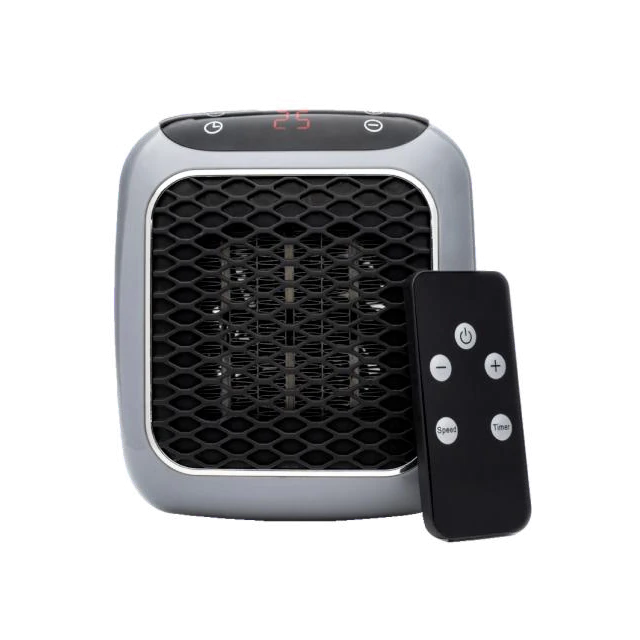
WellHeater: all 6 features on board
- 800 W ceramic heating plates, 400 W low mode
- Thermostat, timer, remote
- Warm in about 5 minutes
Ceramic heaters: modern and efficient
Ceramic (PTC) heaters have a self-regulating heating element: the warmer it gets, the less current it draws. They don’t glow openly, don’t smell “burnt” and are safer than old wire-element fan heaters. The WellHeater* uses exactly this technology – packed into a compact plug-in housing.

Space heater with thermostat and timer
A thermostat is the single most important money-saver. Without one, the heater runs at full power until you switch it off. With a thermostat, you set, say, 21 °C (70 °F) and the heater holds that temperature. Combined with a timer, the WellHeater only heats when you actually need it – handy in a caravan, motorhome or RV on hook-up, or in a garden office or shed with power, too.
Which heater is cheapest to run?
| Heater type | Typical power | Cost per hour at full power* |
|---|---|---|
| WellHeater (ceramic, plug-in) | 400 W / 800 W | £0.10–£0.20 |
| Standard fan heater | 1,500–2,000 W | £0.38–£0.50 |
| Oil-filled radiator | 1,500–2,500 W | £0.38–£0.63 |
| Halogen heater | 400–1,200 W | £0.10–£0.30 |
* At 25p/¢ per kWh. Rates vary by region – around 25p in the UK, around 17¢ on average in the US. The thermostat brings real-world costs down further, because the heater doesn’t run at full power the whole time.
7 tips to save money heating with electricity
- Set the central heating 1–2 °C lower and only top up the room you’re using.
- Close doors – that keeps the heat in the room.
- Use the timer rather than leaving the heater on “just for a bit”.
- Set the thermostat to 20–21 °C (68–70 °F), not to maximum.
- Air rooms briefly with windows wide open instead of leaving them tilted for hours.
- Don’t hide the heater behind furniture or curtains.
- Several small rooms? Several small heaters are better than one big one heating everything.
To see exactly what you’d pay, use the calculator in our WellHeater running cost guide with your own electricity rate.
Frequently asked questions
Which space heater uses the least electricity?
The one with the lowest wattage that’s still enough, a thermostat and a timer – and which only heats where you are. An 800 W heater like the WellHeater uses less than half the power of a 2,000 W fan heater.
Are ceramic heaters more energy efficient?
They don’t convert electricity into heat more efficiently, but they self-regulate and deliver heat quickly. With a thermostat, they save electricity in practice.
Is a heater with a thermostat worth it?
Absolutely. The thermostat prevents non-stop full power and is the biggest lever on your electricity use.
What is the cheapest electric heater to run?
For a small room, a low-wattage ceramic heater with thermostat and timer. At 25p/¢ per kWh the 800 W WellHeater costs at most about £0.20 an hour, compared with about £0.50 for a 2,000 W fan heater.